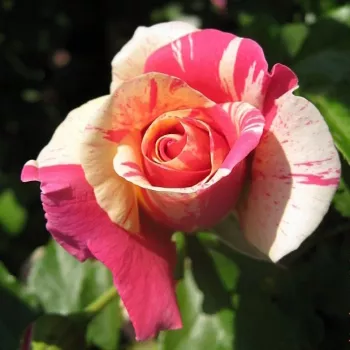
On a vivid mallow-pink ground, irregular cream and ivory stripes appear. - climbing rose, climbing rose - medium-strength, noticeably scented rose - pleasantly sweet aroma
– Striped pink‑cream blooms with playful charm.
– Reliable repeat flowering with generous clusters.
– Medium, pleasantly sweet fragrance in bloom.
– Strong climbing habit for arches and pergolas.
– Medium disease resistance and good hardiness.
– Gné speisialta: Bláth leathdhúbailte oscailte a mheallann beacha agus pailneoirí go flúirseach.
Natural renewal – Pollinator-friendly approach
antoniaROSE® ORIGINAL rós i bpota 2 lítear ar a fhréamhacha féin
23,30 €
5(8028)
WEKROSOPELA – pink-cream climbing rose - Carruth
Bring a touch of cottage romance to your walls and fences with this striped, pink-cream climbing rose that shrugs off breezy, damp Irish summers and keeps blooming through our rainfall-filled months. Candy Land’s medium-height canes are easy to train, dressing pergolas and terraces in colour without overwhelming a small family garden. Semi-double, open blooms invite bees in, so every flush of flowers hums with quiet life. Its own-root nature means steady, reliable regrowth from the base and a reassuringly long lifespan. You simply plant well, mulch for good drainage, then enjoy more flowers each season as roots settle in year one, shoots build in year two, and full charm unfolds by year three. The medium, sweet fragrance completes that soft, green-front-garden mood you can enjoy on any mild Dublin evening.
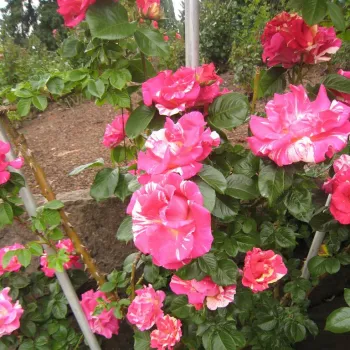
Candy Land climbing rose in full bloom, showing vivid pink flowers with cream stripes.
Candy Land in semi-double bloom with an open centre.
Candy Land shows semi-double blooms with an open centre.
Usage options
Target area
Reasoning
Small pergola beside a patio or deck
Moderate height and spread make Candy Land ideal for framing a modest pergola without casting heavy shade, giving a long, colourful backdrop to family meals outdoors and an easy first climber for the beginner.
Dublin or coastal front-garden fence
The striped pink-cream flowers read beautifully from the pavement, while its manageable habit and repeat blooming offer a welcoming, “girly” cottage look that suits busy urbanites.
Wall-trained accent in a narrow side passage
Climbing growth can be tied flat against a wall, using little ground space but delivering vertical interest and scent in tight areas that appeal to space-conscious homeowners.
Pollinator-friendly family play area edge
Semi-double, open-centred flowers provide accessible pollen, bringing bees into the garden without excessive height, ideal for nature-curious families.
Cottage-style mixed border with shrubs and perennials
Repeat flowering and striped blooms thread colour through the season, pairing well with informal planting so the border always has a focal point for relaxed gardeners.
Feature arch over a path or garden gate
Flexible canes can be curved over an arbour or gate, creating a charming, flowered entrance that remains manageable for training and pruning by time-pressed owners.
Large container on terrace or balcony (40–60 litres)
Own-root growth and medium vigour suit a big pot, provided drainage is good; this allows repeat flowering and a romantic focal point close to the house for container-focused growers.
Screening for seating areas in damp, breezy gardens
The dense, glossy foliage and climbing habit create a soft screen that still performs in cool, moist air, coping well with long spells of showery weather prized by coastal gardeners.
Styling ideas
Cottage-Stripe Arch – Train Candy Land over a metal or timber arch with soft blue nepeta and white campanulas at the base for a storybook entrance – ideal for romantic cottage-garden lovers.
Soft-Front Welcome – On a Dublin terrace, fan the climber along railings with underplanting of lavender and pink hardy geraniums to echo its tones – perfect for busy city homeowners.
Bee-Friendly Screen – Combine this semi-double rose on wires with late-summer anemones and oregano to keep nectar flowing – suited to wildlife-minded families.
Patio Pergola Retreat – Let Candy Land scramble lightly over a small pergola, with pots of scented herbs beneath, to create a sheltered reading corner – great for scent-focused gardeners.
Container Showpiece – Grow it in a 50-litre half-barrel with trailing thyme and heucheras to soften the rim for a compact but lush display – designed for space-limited balcony growers.
Technical cultivar profile
Parameter
Data
Name and registration
Registered as WEKrosopela, marketed as Candy Land and WEKROSOPELA – pink-cream climbing rose - Carruth; large-flowered climbing rose belonging to the climber, large-flowered climber group.
Origin and breeding
Bred by Thomas F. Carruth in the United States in 2006 from ‘Rosy Outlook’ × ‘Pretty Lady’; introduced after 2008 by Weeks Roses following 2008 registration.
Growth and structural characteristics
Medium-vigour climbing habit reaching about 240–360 cm high and 160–260 cm wide, with dense, glossy mid-green foliage and moderate prickles suitable for training on supports.
Flower morphology
Semi-double, cupped to flat-opening blooms with 13–25 petals, borne in clusters on medium-length stems; remontant, providing good repeat flowering with an abundant second flush.
Colour data and phenology
Vivid mallow-pink base with irregular cream and ivory stripes; buds deep carmine pink with cream tips, lightening through pastel pink and off-white as flowers age; colour retention moderate.
Fragrance and aroma
Medium-strength, pleasantly sweet perfume noticeable on still days; fragrance combines with the bicoloured petals to make it suitable for seating areas and frequently used garden paths.
Hip characteristics
Rose-hip set is generally sparse due to flower form, though occasional ellipsoid, orange-red hips 10–14 mm in diameter may appear if deadheading is not carried out.
Resistance and winter hardiness
Hardy to about −21 to −18 °C (RHS H7, USDA 6b, Swedish zone 3); disease resistance medium for black spot, powdery mildew and rust, with routine monitoring recommended in humid sites.
Horticultural recommendations
Best in full sun with fertile, well-drained soil; space 175–320 cm depending on use; water in dry spells and consider light pruning and deadheading to balance growth and encourage repeats.
WEKROSOPELA – pink-cream climbing rose - Carruth rewards you with long-season colour, gentle scent and pollinator-friendly blooms on a durable own-root framework, making it a thoughtful choice for relaxed Irish gardens.
Detailed product attributes
Product Identification Data
Product Name:
WEKROSOPELA – pink-cream climbing rose - Carruth
Product Type:
antoniaROSE® ORIGINAL - rós i bpota 2 lítear ar a fhréamhacha féin
Flower Colour:
On a vivid mallow-pink ground, irregular cream and ivory stripes appear.
Closed Bud:
Deep carmine pink with pale cream striping at the tip.
Freshly Opened Flower:
Intense pink ground-colour petals are streaked with yellowish-cream stripes.
Full Bloom:
The pink lightens slightly, with the cream-coloured stripes visible in sharp contrast.
Pre-Fading Flower:
The pink fades, softening to pastel pink and off-white tones.
Colour Fading Description:
The intense pink lightens slightly at full bloom, then fades to pastel pink and off-white tones before fading completely; the cream‑coloured stripes remain clearly visible throughout.
Pollinator Attraction:
The semi-double flowers open flat; flower form (simple/semi-double/double) and pollen accessibility make them particularly attractive to pollinators.
Pollinator-Friendly Rating:
Semi-double, open-centred flowers with easily accessible stamens attract bees, making it pollinator-friendly.
Rose Hip Notes:
Rose-hip formation is expected to be limited due to the double flowers; occasionally an ellipsoid, orange-red rose hip 10–14 mm in diameter may appear.
Our product is a rose grown with unique pharmaROSA® cultivation technology!
2 litre, own-root, potted rose.
With shoots appropriate to the season.
With roots thoroughly interwoven through the growing medium.
Quality in line with the requirements of the E.N.A. (European Nurserystock Association).
In unique packaging that prevents damage.
Can be planted during frost-free periods.
True-to-type rose plant with an individual identifier.
The pharmaROSA® own-root potted rose is a well-rooted plant that supports reliable establishment when planted and cared for properly, so it can be planted whenever the soil is not frozen.
Stock: several varieties and several stages of development in a short stock section.Shoot system: intensive growth of fresh basal shoots on a young plant.Root system: presentation of the strong root system interwoven through the growing medium with the pot removed.Balance: mature plant where the development of the root system and the shoots is in harmony.
Information about the videos
The video series is not a “seasonal showcase”, but makes the essence of pharmaROSA® own-root production tangible: how the plant is built, what the root system is like and how the shoots renew themselves. The footage was therefore taken at different times, showing plants at different stages of development, so mixed leaf coverage or differing growth stages may appear in the videos. This is not a “sample” of the batch delivered, but an illustration of how the technology works. The current condition of the rose available to order — typical of the given period and similar to what you can expect to receive in the parcel — is shown at the top of the product page.
Pages for private customers Garden roses for the family garden, with minimal care → ORIGINAL® Premium garden roses – instant impact, a truly showpiece garden → EXTRA® Pages for professionals and private customers Roses for public spaces – large areas, sustainable maintenance → NATURAL® Roses for projects – hedge and row planting, fast implementation → RAPID® For professional partners only Production – propagation material for garden roses, wholesale → NEONATAL®
Sonraí cuideachta
PharmaRosa Ltd. Company registration number: 01-09-717479 VAT number: 13075314-2-43 Plant health registration no.: HU130721 Bank account (IBAN): HU85117631891388688400000000 BIC (SWIFT): OTPVHUHB Bank name: OTP Bank Nyrt.